Remember the goal is 70* days and 50* nights. We have yet to have temperatures like that at this point.
Sunday, March 31, 2019
Practice Facility
The practice facility was mowed out for the first time last week and looking great. We have a week of cold weather to endure and then hopefully we’ll be back in the 60’s.
Friday, March 29, 2019
Tee Fertilization
Chad is busy fertilizing tees with a 13-4-13 fertilizer to give them a little kick this spring. We will be doing a wall to wall fertilization in 2 weeks to cover the entire golf course. This application is a slow release Polyon product that is coated with pendamethalin, a crabgrass pre-emergent.
Thursday, March 28, 2019
Greens Rolling
We are working our way our the course rolling greens 2 directions with this. This helps tremendously to smooth them out for the season. The greens have a way to go to heal from aerification and will do so once it warms up consistently. I will say the course is in great shape given the cool weather...in fact, this is the best I've seen it for late March. I do want to stress however, that the greens do have a lot of healing to do from our aggressive aerification practices.
Sent from my iPhone
Golf Champ!
Anna won the 2019 Tri-State Conference Middle School Golf Tournament, held yesterday at Sky Valley GC.
Thursday
New sod on the right side of #1.
You can see the effects of driving on frosty turf. It will recover in another week or two but it's not pretty.
#16 Shade
Excess shade continues to be a problem on the 16th green and why we can't achieve quality, consistent turf cover on this green.
Dredging #10
Dredging started on the 10th hole today. The material is being pumped into a large sediment collection bag located behind the 14th green. Once the water drains from the bag after the project is complete, we will cut the bag open and haul it off.
#10 Complete
It's great to see the #10 tee box completed and sodded right to the edge of the cart path. I have no doubt that this project will be well received by the membership this spring.
Club Lake
These fresh water mussel shells are piled up in a couple different areas along club lake. This is interesting and I'm curious what it eating them??
Wednesday, March 27, 2019
Wednesday
Above, we have a 2 ton roller on the greens today, rolling them 2 directions. This is necessary given the amount of disruption by aeration that was recently done. It does a great job smoothing them out.
Below, our final load of sod is being installed.

Weather Forecast
Here is the 7-day forecast for the coming week. It is still on the chilly side for active turf growth- something we won't see until the day temperatures reach 70 and nights reach 50*F.
Tuesday, March 26, 2019
Bunkers
The team has started to prep the bunkers for play and they are looking great. It's important to start early on bunker raking in order to soften the sand up before the season. We will rake them a few times a week to have them in good order and playable once the course opens on April 12th.
USGA Meeting
The last few days, I spent at Clemson University for the annual USGA meetings.
We played golf on Monday at the Walker Course at Clemson University. It’s a pretty good university course. You can see the attention grabbing cart path only signs used at the course! This course has diamond (variety) Zoysiagrass greens, which was a 1st for me. The greens rolled great and look like Bermudagrass, to me. Zoysia is slightly more tolerant of shade compared to Bermuda and the reason they decided on Zoysia greens.
Monday morning, the Carolinas GCSA met...the organization that I serve as Vice President of.
The famed “Tiger Paw” hole on the Walker Course.
We had a great educational event all day Tuesday with a number of great speakers.
Prepping #3 Bank
This area is extremely difficult to maintain due to blistering sun exposure and lack of irrigation. Therefore, it tends to die from drought stress each year. We are prepping the the area to reseed it with fine fescue. The means getting out all the dead turf and thatch in order to create a nice seed bed. We will cover it with a geo-textile fabric to be sure it stays damp to allow the see to germinate.
New Equipment Delivery
Our new equipment was delivered yesterday- a fleet of Toro fairway and rough mowers. This equipment is leased on a 4-5 year rotation. Equipment like this that accumulates high hours (mowers accumulate hours just like your vehicle accumulated miles) is worth leasing as opposed to outright purchasing. However, equipment that has a long life expectancy or the technology doesn’t change as much, is worth purchasing. An example of this is a reel grinder that we can keep for 10 years or more. On the flip side, greens, tees, rough and fairway mowers are all leased.
Edging Yardage Stones
I mentioned we are tackling details daily and one such example is edging all sprinkler heads and yardage stones on tees and fairways.
Monday, March 25, 2019
Sod Preperations
Wednesday, our final load of bluegrass sod will be delivered. This means we are spending a majority of the next couple days prepping areas like #10 to be ready for sod. After Wednesday, #10 will be complete which is kind of exciting! Everyday, we continue to knock out many of the details that are needed for our April 12th opening day.
Fertilize greens
With rain set to start about noon, we have 3 different nutrient products going out. A potassium 0-0-50 fertilizer, Pro Mag (Magnesium Product) and finally an 18-9-18 fertilizer will be added to give the greens a boost into spring.
Friday, March 22, 2019
Greens Fertilizer
We are starting to feed the root-zone below the turf on the greens to build up nutrient reserves going into Spring. Matthew is applying a high rate of Calcitic Lime today to add calcium to the soil. Next week, we have a couple more products to apply including Magnesium, Potassium and Nitrogen. We will be pressuring up the irrigation system next week as well. This will allow us the ability to irrigate these products into the soil. Also next week, we will be rolling greens with a 2-ton asphalt roller two directions to get them smoothed out for the season. The greens have quite a bit of healing to do from aerification and probably won't be really smooth until May, like most years.
#16 improvement
Chris is working on an attractive dry creek bed where a tremendous amount of water is coming off the cart path on #16. It was a brutal day in Highlands with temps in the 40's and winds close to 30 mph. Grass is definitely not growing at this point.
Thursday, March 21, 2019
New Growth
This is a great photo of a cross section of the 15th green taken by Harold Davis. You can see individual grains of sand along with the new roots and shoots emerging from the crowns of the turf.
Incidentally, we are proud of Harold, who taught a 2 hour class last night at the Bascom, presenting to the Bascom photography club! He is incredibly talented and I know those in attendance gained a lot from it!
Thursday
We are finishing our spring cultural practices by aerifying the chipping greens at the practice facility. We are also doing the croquet lawns again as well. Below, the Hudson House is a focus of ours all winter and we are often called on to help with the work being done there. Today, we hand dug a trench to connect the fiber optic cable from a junction box at the LEC to the new building.

Wednesday, March 20, 2019
A Video you can’t miss!
Many thanks to Security Officer, Bill Brooks for catching this on camera!
A bald eagle snags a trout out of the pond on the 18th hole!
Wednesday
Jerry and Gary are laying down some lasers!
Above, asphalting on the 10th hole.
I love this view of the 10th hole!
We did some major repairs to the drainage basin behind the 8th green. Soil was cavitating around the basin, creating a dangerous and unsightly situation. We poured concrete around the basin after making the repair. We'll top this off with soil and sod.
The asphalting on #10 is complete and looks great. We'll be filling and sodding the edges in the coming week.
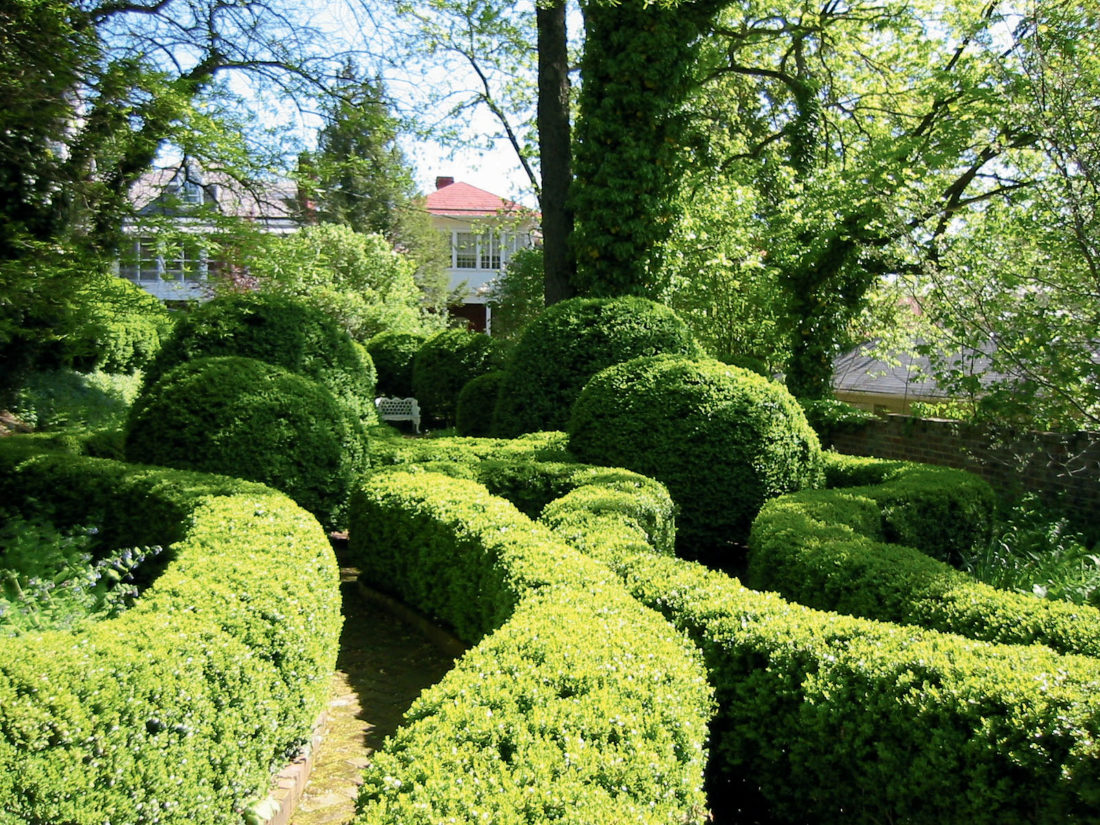
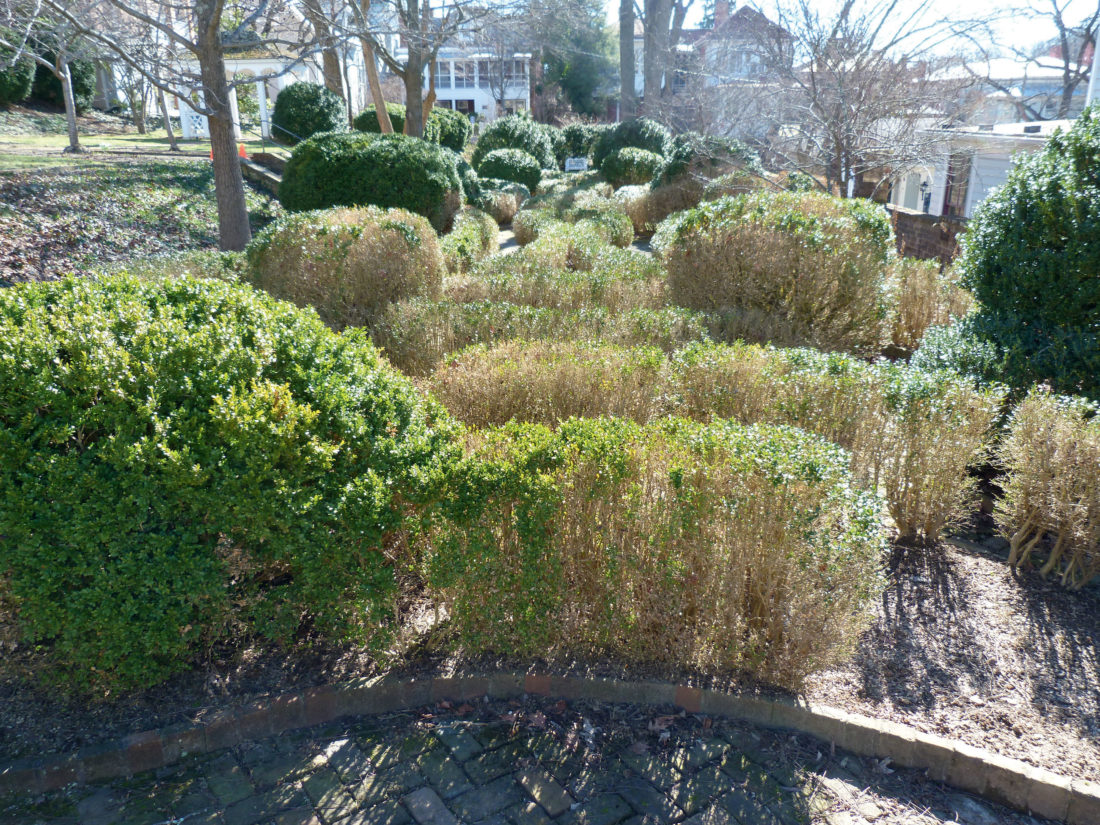
Boxwood Blight- Garden and Gun Magazine
CONSERVATION
Boxwood Blues
A Virginia nursery fights back against a blight wiping out one of the South’s most beloved plants
by LOGAN WARD
April/May 2019
Josh Meyer was ten days into his position as the director of buildings, gardens, and grounds at Tudor Place Historic House and Garden in Washington, D.C.’s Georgetown neighborhood when a staff gardener told him something was up with the boxwood. This was on a Friday last October, and Meyer, trained as a landscape architect, didn’t think much of the minor defoliation and leaf spotting. “But here’s where it gets crazy,” he says. “We came back on Monday, and the symptoms had spread to pretty much all the collection areas. You could see this thing just descending on the property.”
The “thing” was boxwood blight, a fungal disease wiping out generations-old boxwood with the heartless efficiency of an Ebola epidemic. Within weeks, the blight had stricken one-third of Tudor Place’s boxwood, leaving sections of the branches leafless and streaked with black cankers. Tudor’s gardeners, cloaked in disposable white Tyvek coveralls, removed the infected plants, leaf litter, and soil, taking care to double-bag everything to avoid spreading the spores,
a method they learned from the Virginia Boxwood Blight Task Force, whose members come from Virginia Tech and various cooperative extension offices. The scene was like something out of a creepy movie. “Boxwood blight looks horrible,” says Norman Dart, a plant pathologist with the Virginia Department of Agriculture and Consumer Services. “It scares people.”
As well it should. The fungus thrives in warm, wet weather and, when conditions are less than ideal, hunkers down and waits. It can survive at least five years dormant in the soil and probably longer. When spring rains come, the fungus showers plants with clusters of tiny white spores that consume the shrubs, browning leaves and blackening branches. The most susceptible variety—Buxus sempervirens Suffruticosa, the English boxwood, revered in the South for its use in parterres and topiary—defoliates within two weeks, so desiccated it looks as if it’s been burned.
Initially reported in the United Kingdom in the 1990s, the fungal pathogen Cylindrocladium pseudo-naviculatum first surfaced on this side of the pond in 2011 at a couple of North Carolina nurseries. State plant pathologists swooped in to identify and try to contain the blight, but they were too late. The spores quickly spread, destroying boxwood farms large and small. Kelly Ivors, a plant pathologist whose North Carolina State University lab first identified the fungus in the United States, remembers meeting a woman who had invested in boxwood farms for her retirement. The distressed woman said she was going to put the matter in God’s hands. “I was frank with her,” recalls Ivors, who now works for a commercial fruit grower in California. “I told her God was probably telling her that she wouldn’t be growing boxwood in five years.”
The spores, which also affect pachysandra and sweet box, are heavy and sticky. They don’t spread long distances by air, but they will splash from plant to plant, and they cling to clothing, animals, and garden tools. Around the time it was discovered in North Carolina, the blight showed up in Connecticut, and then Oregon and Virginia, probably transported through the nursery trade and even via ornamental wreaths shipped by mail. Since then, it has emerged in twenty-six states total, but mid-Atlantic spots such as Virginia, with its historic boxwood and ideal conditions for both growth and blight, have been hit particularly hard.
In 2015, boxwood blight decimated the crown jewel of the historic landscape at the Woodrow Wilson Presidential Library and Museum in Staunton, a bowknot garden designed in 1933 by Charles Gillette. Then last year’s record-breaking East Coast rains brought the blight back with a vengeance, and the property had to remove another seventy-six bushes. “We have zero boxwood now,” Robin von Seldeneck, the library’s president and chief executive officer, says, other than new test plants. “That left a lot of broken hearts in our community.” The 2018 epidemic affected countless private and public gardens across the state, from Williamsburg, to farms along the James River, to neighborhoods in Martinsville; some even resorted to burning the shrubs to address the blight.

PHOTO: COURTESY OF THE WOODROW WILSON PRESIDENTIAL LIBRARY PHOTO COLLECTION
The bowknot garden at the Woodrow Wilson Presidential Library and Museum in Staunton, Virginia, before boxwood blight.

PHOTO: COURTESY OF THE WOODROW WILSON PRESIDENTIAL LIBRARY PHOTO COLLECTION
The bowknot garden after boxwood blight.
Charles Stick, a Charlottesville landscape architect, calls the blight “extremely alarming, one of those earth-altering circumstances.” Stick has loved the shrub since his student days at the University of Virginia, when a first beguiling whiff of boxwood set him on a course of designing classically inspired gardens. “The talk around town,” Stick says, “is Well, I don’t think we should invite the Smiths to dinner because they’ve got boxwood blight, and they might bring it on their trousers.” Stick can relate. Boxwood, including a design propagated from sprigs plucked nearly a century ago from James Madison’s Montpelier, dominate the gardens at his own home, the historic Waverley Farm. Stick requires landscapers at Waverley to use disinfectant on their feet and equipment. “The garden is just too precious to mess around with,” he says.
Josh Meyer and his colleagues at Georgetown’s Tudor Place are working overtime to save their property’s centerpiece, an elliptical design of two-hundred-year-old plants whose thick, gnarled branches delight visitors. “If we had to replace them all with tiny boxwood, it would remove the last visual vestige of the 1800s understory,” Meyer says. Even swapping blighted shrubs for new ones isn’t foolproof, since the spores are so difficult to remove from soil. Some are choosing boxwood alternatives, such as certain holly varieties. Others, like the Wilson Library’s team, haven’t decided yet. “We want to keep the bowknot garden,” von Seldeneck says, “but we’re definitely not going to use boxwood.”
A new cultivar recently released by a Virginia nursery, however, may offer hope. Long before the blight landed on American soil, Bennett Saunders—among the third generation of owners of Saunders Brothers, a Piney River nursery that’s one of the largest boxwood growers in the South—worried about the fungus. For two years, he carried a scrap of paper in his billfold with the pathogen’s scientific name, scrawled down for him by a distraught Belgian boxwood grower he had met in the mid-2000s at a European Boxwood & Topiary Society meeting. When the blight finally surfaced in the United States, Saunders flew to Europe to prepare for battle, interviewing growers who had been fending it off for years.
Certain varieties, he learned, are more tolerant than others. So Saunders Brothers began sending samples of the 150-plus cultivars they had collected over the years to Kelly Ivors, the N.C. State pathologist, to test their susceptibility. For the past seven years, the nursery has been working to propagate the cultivars that resisted blight best, such as Green Beauty—a slow process because boxwood only grow two to three inches a year. Finally, at the Mid-Atlantic Nursery Trade Show in January, Saunders Brothers announced the imminent release of NewGen, its line of blight-tolerant boxwood. Under the most extreme pressure, the NewGen cultivars will show some lesions and leaf browning, but they tend to survive, especially when combined with proper plant management, such as mulching to suppress the spread of spores. The glossy-leaved NewGen Independence most resembles English boxwood. “It brings joy to my heart to see that Saunders Brothers has blight-tolerant boxwood that are commercially available,” Ivors says. “Without their collaboration, I don’t think we would be anywhere close to where we are today.”
“This is not a silver bullet, but we think it is a huge step forward,” says Saunders, who last year ripped out the English box from his own front yard and replaced them with NewGen Independence. “While I won’t see our new boxwood mature to the size and grandeur of what they are replacing, this is the fight of my life.”
Another Proud Dad Moment...
Anna shot 11 shots better than her coed competition to finish 1st place in her last Tri-State Conference golf match! Proud of her!
Tuesday, March 19, 2019
Tuesday
We are finally able to pave the cart path at the 10th tee box. The paving crew is doing their best to wrap this up today.
Our verticutting team is wrapping wrapping up the practice green. When the PG is complete, we need to finish #10, #11, #14 and the croquet lawns and then this process is done. This allows us 2 weeks to hammer out the details prior to opening April 12th.
The girls continue to do a great job helping us get the clubhouse grounds cleaned up and mulched.
Arborcom is Back Onsite...
Last December, we embarked on a shade study on several of our worst greens. On December 8th, a snow and ice storm cut the study short. Therefore, Scott Robinson returned to Highlands today, after finishing up a shade study at East Lake GC in Atlanta. The plan is to work for 3 days and then present the results to committee chairman, Mr. Suthers and I on Thursday afternoon.
Sunday, March 17, 2019
Saturday, March 16, 2019
Friday, March 15, 2019
Bears Under a Home
This is a video taken by our HCC Security team at a home on Upper Brushy Face. A bear and 3 cubs are living in the crawl space of a member home!
Forecast
Next week, we'll have cold nights and mornings, but we haven't had a stretch this long of no rain! We are excited to get a lot of our spring prep done next week. Last night, we received 1.85" of rain. As I write this, it is raining very hard and will continue all day.
Thursday, March 14, 2019
Subscribe to:
Comments (Atom)